Key concepts
Roadie uses a small set of concepts to describe what is planned, when it is expected, how larger outcomes break down, and what depends on what. This page introduces those concepts and how they fit together.
Roadmaps
A roadmap is a self-contained plan. You might create one for a product, a system, a programme, or a team. Roadie can hold many independent roadmaps.
A roadmap organizes items and milestones into contexts. It may also define a schedule and dependencies between its items and milestones.
Contexts
A context groups work by an enduring concern that helps readers understand the plan—for example a product area, subsystem, or team. Every item and milestone belongs to a context.
Each context has a colour that identifies its items and milestones throughout Roadie.
Items and child items
An item is a meaningful result that takes time to achieve and matters to the wider plan. It has a recognizable finish, and its timing, priority, or dependencies deserve separate attention. Each item has:
- a title and description;
- an inclusive start and end date;
- optional priority and labels;
- an optional attention flag;
- optional planning signals for tentative timing and risk;
- optional dependencies on other items or milestones.
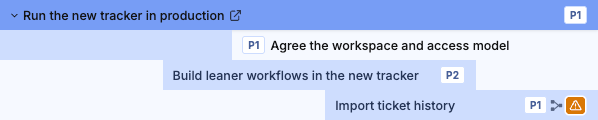
An item may have child items, providing one deliberate level of decomposition. Child items have their own dates and attributes. The hierarchy stops there: a child item cannot have children of its own. This is deliberate: deeper hierarchies tend to turn a roadmap into a nested task tracker, obscuring the outcomes and relationships the roadmap is meant to communicate.
Milestones
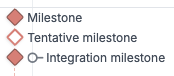
A milestone marks a significant date: a decision, release, review, handover, or other event with no duration. Unlike an item, it is a point in time rather than work spanning a period. Its date may be tentative, shown as a hollow diamond.
Milestones can participate in dependencies, so a plan can express that an item must finish before a decision date, or that later work depends on a milestone.
Integration milestones
An integration milestone is a milestone made available to other roadmaps. Those roadmaps can link it into their own plans and make local work depend on it.
Together, the integration milestone and its links form an integration seam: an explicit handoff between independently maintained plans. Integration seams are a key ingredient in making planning scale. Each roadmap can stay focused while still showing where it connects with others, so work can span many planning scopes without one roadmap containing all of it.
Views
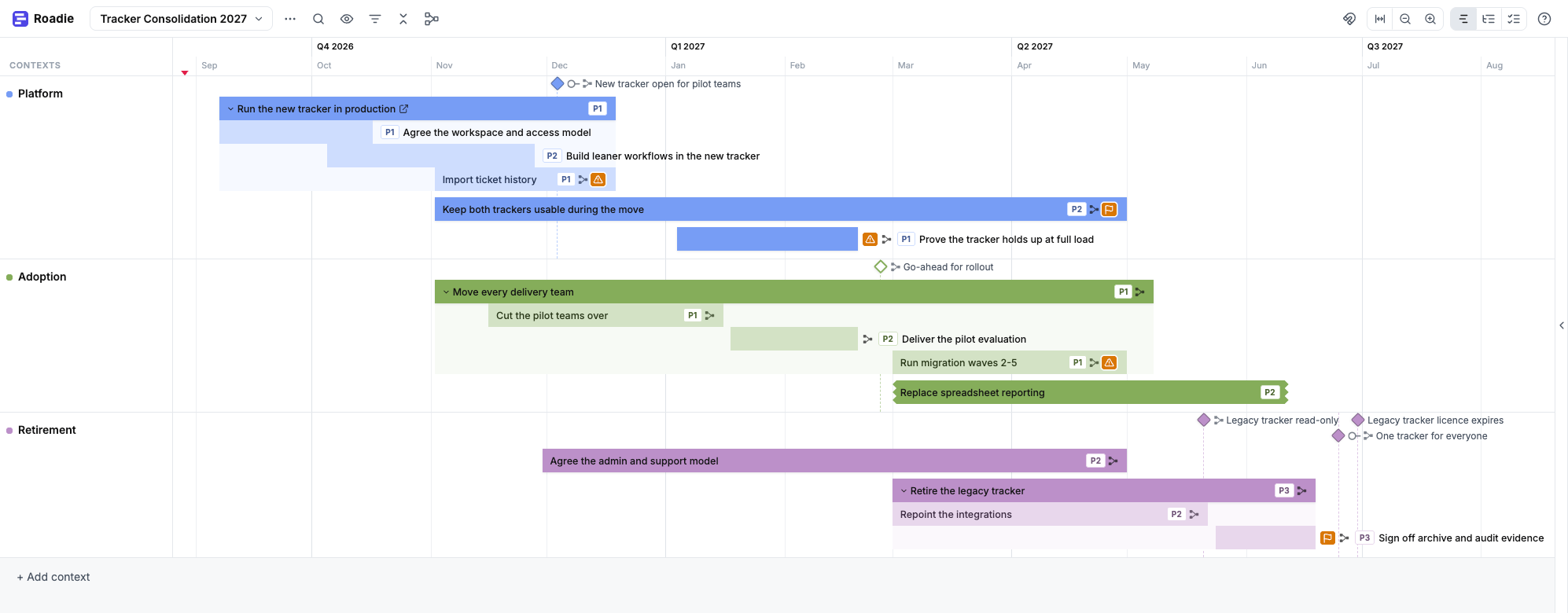
Roadie offers two views of a roadmap. The timeline emphasizes when things are planned: item bars span their planned dates, milestones appear at their dates, and contexts form horizontal swimlanes.
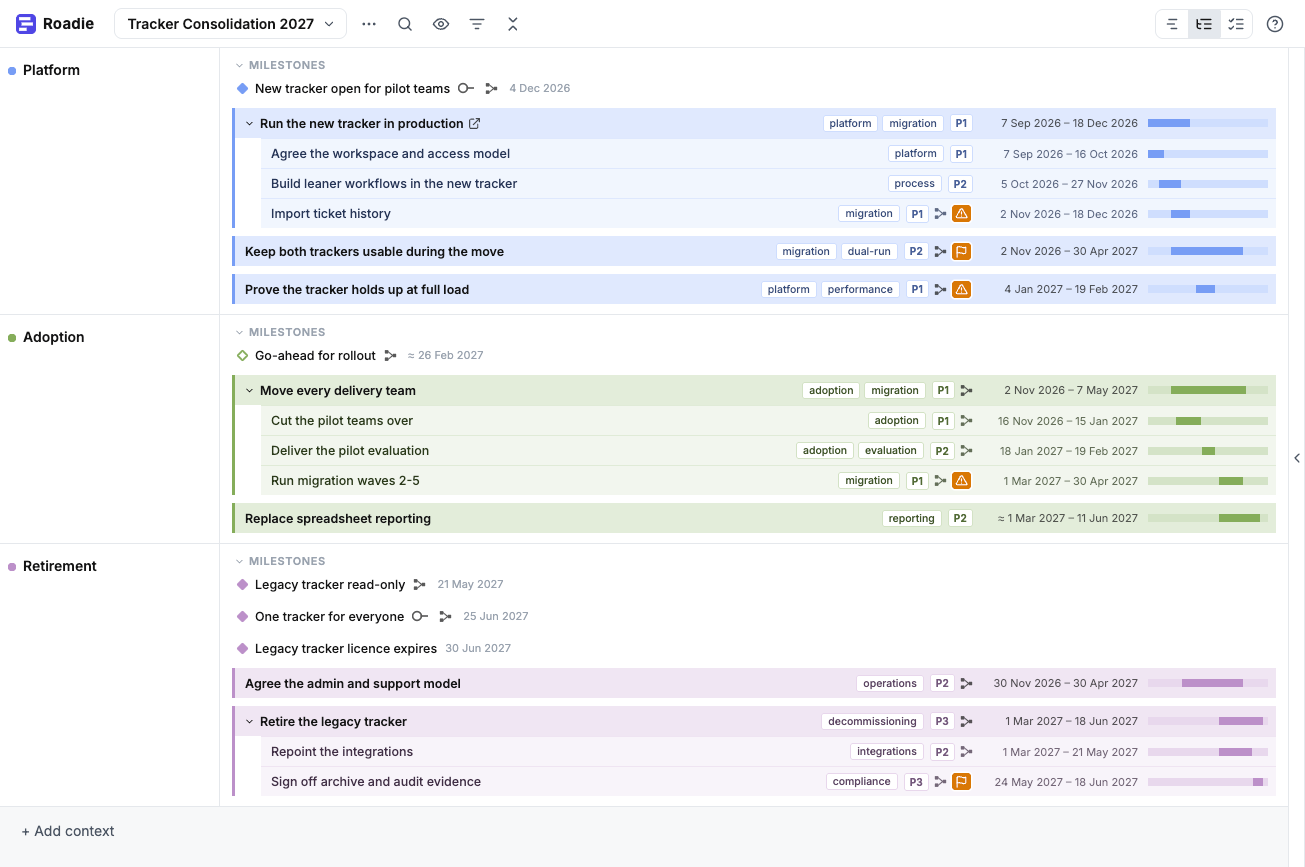
The Work Breakdown Structure (WBS) view emphasizes structure. It shows the same content as an ordered hierarchy, making context membership, parent-child relationships, labels, and ordering easier to scan.
Schedule
Roadie can organize a roadmap directly by calendar periods, using days, weeks, months, or quarters as its time grid.
Organizations that plan to their own rhythm can define a sequence of named schedule periods, such as sprints or Planning Intervals (PIs). Items retain their calendar dates, while the schedule relates those dates to the organization's planning cadence.
Dependencies
A dependency is a directed relationship between two items or milestones: the dependent needs the prerequisite. Roadie keeps one dependency kind—there are no edge types, lag values, or labels—and prevents dependency cycles.
Because an item typically describes an outcome, a dependency reads as "B is not achieved until A is", rather than "B may only start once A is finished": dependent work routinely overlaps its prerequisite.
Roadie therefore warns only when a prerequisite is scheduled to finish after the work depending on it, not when the two merely overlap. It never reschedules the plan automatically.
Roadie shows an entity's immediate prerequisites and dependents, never the whole graph at once. A chain is followed by moving from one entity to the next, which is what keeps the plan free of a spaghetti of dependency lines.

Metadata
Roadie keeps metadata deliberately limited:
- Priority is an optional P1–P4 ordering signal, with P1 highest. It says that an item matters more or less relative to other roadmap items; it is not execution status.
- Labels are free-form terms shared across a roadmap. They classify items and can be used to filter the current view down to them.
- A flag means that an item needs human attention. It is intentionally a single, lightweight marker with no type, owner, due date, or workflow.
- Tentative timing means that an item's dates or a milestone's date are an estimate rather than a commitment—typically when planning is distant or not yet well understood. The timeline draws tentative items with ragged ends and milestones as hollow diamonds. The WBS uses "≈" for both and also keeps the hollow milestone diamond.
- At risk means that an item's dates are still the plan, but something now threatens them. It is shown as a warning triangle.
An item can be tentative, at risk, and flagged at the same time. Each signal is a yes or no with no further detail: Roadie has no confidence percentages and no off track, blocked, or done states.
Roadie does not track execution progress. Percent complete and task states belong in work-tracking systems, not in the roadmap itself. These signals say how much to trust the plan, not how much of the work is done.
External references
Items and milestones can reference Jira issues, documents, and other external resources by including links in their descriptions. For items, the first link is the primary reference and can be opened directly from the timeline or WBS; all links remain available when editing the item.
Roadie treats external references as links, not synchronized copies. With a Jira connection, it can read linked issues on demand to find missing references or compare schedules. It does not reproduce Jira's hierarchy or derive roadmap progress from issue status.